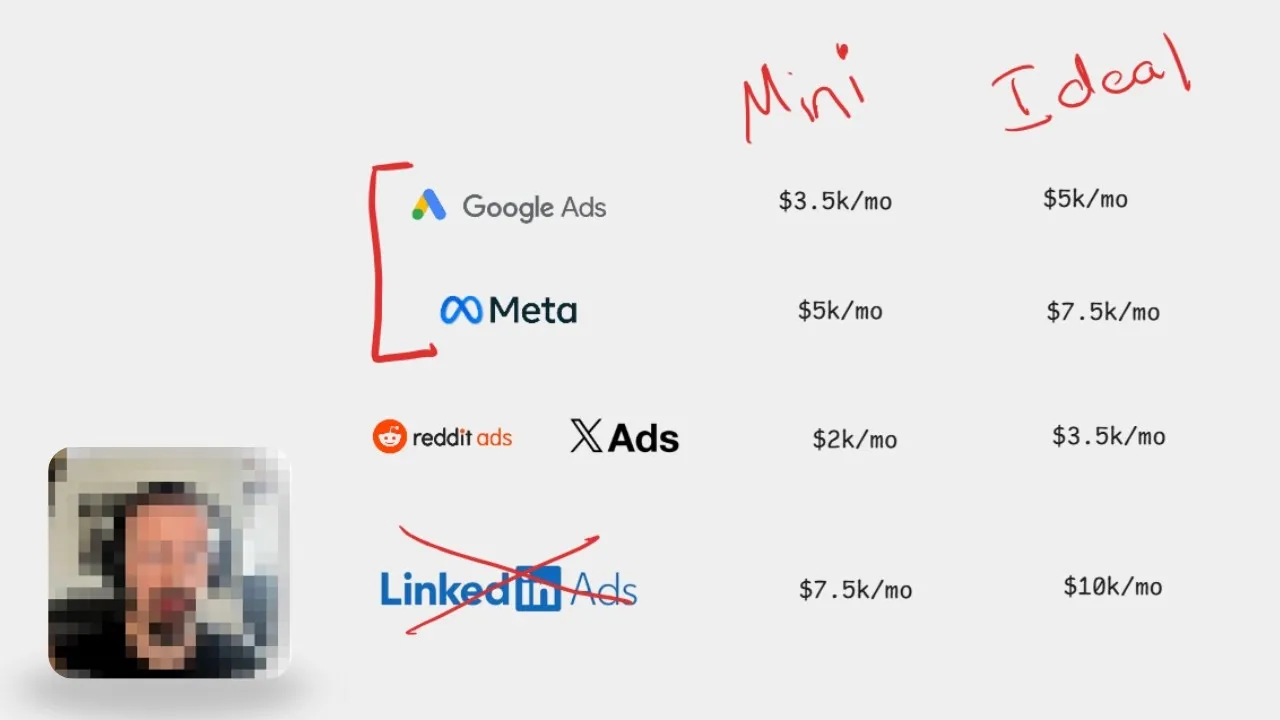
TL;DR: Google, Meta and Reddit are not three versions of the same job. Google is a keyword structure problem, Meta is a creative concept problem, and Reddit is a distribution copy of whatever already works on Meta. The account structure for each one falls out of which of those three it is.
Where part one left off
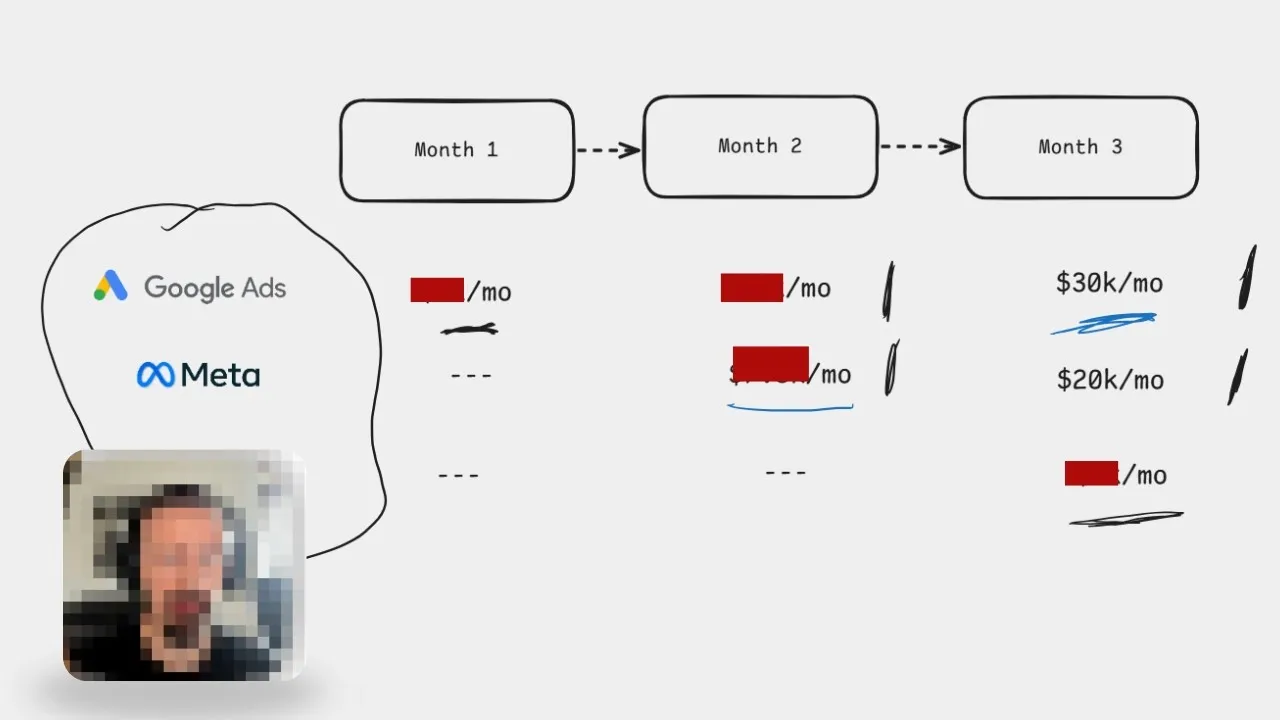
Part one covered the foundation: the attribution setup, which two channels to launch, and how the budget ramps from roughly $13k in month one to $50k in month three. It deliberately stopped short of what goes inside the accounts.
This is that part. For each channel I’ll cover six things: how to start it, what it looks like at launch and at scale, an example of that structure, how much sits in each campaign, what to watch out for, and how you get better at it.
Google leads because it pays back fastest. Meta comes in month two, Reddit in month three, and the money moves like this.
| Channel | Month 1 | Month 2 | Month 3 |
|---|---|---|---|
| $5,000 | $15,000 | $30,000 | |
| Meta | Not launched | $7,500 | $20,000 |
| Not launched | Not launched | Small and experimental |
That month-one Google number isn’t big enough to waste, and it’s enough to build a skeleton account and prove the channel, with a little room to test.
How should a Google search account be structured?
A Google search account is built around six groups of keywords, and it’s the same six whether you’re B2B, B2C or ecommerce. Intent-based, subject-based, feature-based, conquesting, dynamic retargeting and brand. Under each group sit ad groups, then ads, then your primary bidding event, as I lay it out at 2:20.
With $5,000 in month one, almost all of it goes into intent and subject. Roughly 80% there, 15% into dynamic retargeting and 5% into brand, and the last two only if you already have traffic arriving from somewhere else. That’s a skeleton account, and it’s the right shape to start from.
Intent, subject and feature keywords
The three keyword types are a ladder of intent, and they’re easiest to see through an example. Say you sell analytics software.
An intent keyword is action-based: somebody searching measure conversions from ads is trying to do the thing your product does. A subject keyword is around the category: analytics tools, software to measure traffic. A feature keyword names a specific capability that happens to have search volume, like first click and last click attribution modelling.
Break similar keywords into their own ad groups. Five distinct groups of keywords means five ad groups. Run responsive search ads everywhere, and make sure the headlines match the ad group, so somebody searching for analytics tools sees an ad about analytics tools, not one about attribution modelling.
One rule across all of these: bid on conversion events only. In B2B that’s more involved than it sounds, and it’s the subject of its own breakdown on which event to bid on first.
Conquesting your competitors’ keywords
Conquesting means buying your competitors’ brand terms, their name plus alternatives, their name plus reviews. You’re borrowing somebody else’s awareness to take conversions out of their funnel.
Costs per click are high, because you’re bidding on a name that isn’t yours, and click volume is usually low. That’s why it isn’t a month-one campaign. Month two or three, depending on how the budget scales.
It is, however, an extremely effective way to get qualified users. If the problem you’re having is lead quality rather than lead volume, this is one of the better answers to it.
One warning. If you’re running responsive search ads on a conquesting keyword, be careful about putting the other brand’s name in the ad copy. Where trademarks are registered with Google Ads, they can issue a takedown. You’re generally not penalised for it, but it’s a tedious thing to keep fighting, so work out what language you can use before it becomes a recurring problem.
Dynamic retargeting and branded campaigns
Dynamic search ads match an audience to a landing page. I’d set one up in its own ad group and choose both the audience to retarget and the pages to retarget them with.
The shape is: somebody arrives, browses, has never heard of you, and disappears. If they spent real time on the site you can treat that as high signal and put them in an audience. A month later they’re searching your competitor’s pricing, and that’s when your bottom-of-funnel page shows. Only launch it in month one if there’s enough traffic for it to matter, otherwise it’s a waste of the budget.
Branded campaigns and impression share
Branded campaigns are an argument every time. The objection is that you’re paying for people who were already coming to you. My view is that a small amount of spend, 1 to 5% and always on, is incremental, and we’ve tested that across clients.
What you should watch is impression share, which I get into at 10:46. Brand is the one search campaign to run on a target impression share, aiming to show for around 70 to 75% of searches on your own terms. Keeping it live also makes it more expensive for competitors to conquest your brand and poach the revenue. And once other channels are running, the awareness they generate turns up as branded search, which is when this campaign starts genuinely paying for itself.
| Campaign type | What it buys | When to launch |
|---|---|---|
| Intent keywords | Somebody trying to do the thing you do | Month 1 |
| Subject keywords | The category around your product | Month 1 |
| Feature keywords | A capability that has search volume | Month 2 |
| Conquesting | Competitor brand terms | Month 2 or 3 |
| Dynamic retargeting | Past visitors, searching again | Month 1 if traffic allows |
| Brand | Your own terms, on impression share | Always on, 1 to 5% |
Getting good at search
Three things: find new keywords, raise quality scores, improve ad copy.
For finding keywords, keep one broad match in each ad group and make the rest exact. The broad match exists to surface search terms that are close to what’s already in that group but not covered by your exact keywords. When a search term starts producing leads consistently, promote it to an exact match keyword of its own. Add negatives over time.
Negatives are the other half of that. Keep the targeting tight with exact match first, then eliminate the bad quality around it as the search terms report fills up. It’s a weekly habit, not a one-off. It’s also the difference between a tight account and one quietly paying for traffic that was never going to convert.
Quality score is a function of your ad copy and the landing page behind it. Google is checking that the searched keyword matches the ad, which matches the intent, which matches the page. Improve either end and the score follows.
Why are Demand Gen, PMax and Display $0 at launch?
Because with $5,000 and an empty account, search is simply higher intent, and in B2B that difference shows up as qualified leads rather than leads in general. Launching visual campaigns on top of no data produces volume you then have to sort through.
When each one earns its place
Once there’s budget, the differences between those three campaign types matter less than people think. What actually differs is static versus video, prospecting versus retargeting, and how you’re targeting. My preference is simple: if I’m running video I want to be on creator YouTube channels, which means Demand Gen or Display. If I’m uploading an ABM account list, that’s Display, because it’s the only one that takes the list. Same for targeting industry URLs or competitor URLs.
| Campaign type | Reach for it when |
|---|---|
| Demand Gen | You are running video on creator YouTube channels |
| Display | You have an ABM account list, industry URLs or competitor URLs |
| PMax | The account has data and the audiences are genuinely tight |
Before launching any of them I want about 25 top-of-funnel lead conversions and more than 10 bottom-of-funnel revenue conversions in the account. That’s the bare minimum for the platform to have something to work with.
Where they fail
These campaigns fail on placement control and negatives. Somebody launches PMax with broad targeting for a product that’s sellable to 15,000 people on the planet, and it fails because the fundamentals never worked. The reports will show you where your ads actually ran. Most people never go and apply the negatives, and end up spending a thousand dollars in the promotions tab of Gmail.
One last thing on Google. By month three, at $30k, you’ll have spend in these campaign types, and the creative should come from Meta. Creative testing is difficult on Google and easy on Meta, so your top-performing Meta concepts become your Demand Gen, PMax and Display assets.
How should a Meta account be structured?
A Meta account looks nothing like a Google one, and the comparison isn’t much use. Meta launches in month two at $7,500 and more than doubles into month three. Month one of the channel runs roughly 90% prospecting and 10% retargeting, moving to about 85/15 as it scales.
The ad set is a unique creative concept
Inside a prospecting campaign you have ad sets, and each ad set should be one unique creative concept. A concept isn’t an ad. It’s the intersection of a persona, an offer and an angle.
Keep the persona and the offer fairly stable. The offer is mostly bounded by what you can actually deliver, usually a trial, some onboarding, something around the problem. It only really changes when you’re running content, like a webinar or a downloadable lead magnet. The room to move is in the persona and the angle, which is the structure I walk at 19:19.
The five angles
Angles fit into five buckets here: pain, product, proof, differentiation and downsides.
That’s five here and six in the full angle framework, which adds content as its own angle. Both are right, depending on what you’re doing. When you’re mapping awareness stages, content is its own angle. When you’re building ad sets it’s just the offer changing, because that’s what a webinar is.
Scaling a concept across formats
Launch new ad sets with new concepts continuously. Once a concept proves viable, scale it by changing formats rather than by changing the message, so Meta gets as much ammunition as possible for the same idea.
Take the downsides angle about the CMO spending 17 hours assembling a report for a board meeting. That’s two or three statics, a story version, and five or ten video hooks that introduce and agitate the same idea. Mock customer calls and podcast-style cuts are both working well for B2B right now.
How often to test, and what actually moves Meta
The bare minimum is one creative concept at $25 a day for 10 days. Below that, especially in B2B, you won’t get enough signal to call a concept a win or a loss. You can push it to $40 a day for 10 days and it gets better. The tension is real though: you can spend a lot experimenting and not much converting.
Early on the budget won’t cover as much concepting as you’d like, which is exactly why you dig into sales and customer calls to work out which pain matters most, and for which persona.
Getting good at Meta is ad copy and creative, and after Andromeda it’s close to the only thing that moves the platform. Lookalikes and interest-based targeting used to matter and largely don’t. If those are still your targeting strategy, you’re paying more than your competitors for the same revenue. The one exception is an uploaded lead list: if you’re going after 500 known accounts, check the match rate and run at those people directly.
What should you do on Reddit?
You copy Meta. Reddit comes online in month three as a diversification play, and the job is to get more distribution out of creative concepts that have already proven themselves somewhere with faster feedback. Nothing about the structure or the copy should be new, which is where I close at 28:10.
Use the same ad structure, the same creatives, even the same naming convention, so that campaign and ad group names line up across platforms when you look at them in your attribution tool. This isn’t the place to invent new copy, and it isn’t the place to find out whether a concept works.
That isn’t laziness. It’s a distribution decision, not a creative one.
| On Meta | On Reddit |
|---|---|
| Campaign | The same campaign, same naming |
| Ad set, one creative concept | Ad group, the same concept |
| The creatives that won | The same creatives, unchanged |
| Broad targeting and lists | Subreddits only, never keywords |
The one thing that differs is targeting, and there’s only one correct answer: subreddits. Reddit also offers keyword targeting, but Reddit doesn’t know much about who its users are, what they search, or what that search is worth. It’s a waste of time. And if the subreddits you need don’t allow ads inside them, don’t run Reddit at all.
Three channels, three different jobs
Put Google, Meta and Reddit side by side and the reason the three account structures look nothing alike becomes obvious. Each one rewards a different kind of work, and the account is shaped by which kind.
| Channel | What it actually is | Comes online | How you get better at it |
|---|---|---|---|
| A keyword structure problem | Month 1 | Mine new keywords, raise quality score | |
| Meta | A creative concept problem | Month 2 | Test concepts, scale winners across formats |
| A distribution copy of Meta | Month 3 | Nothing new. Reuse Meta, subreddits only |
Get that backwards, by running Meta like a keyword account or Google like a creative account, and both underperform for reasons that look like channel problems and aren’t.
If you’re building this from nothing, the budget ramp and attribution setup get decided first. The landing pages these accounts point at matter as much as the accounts do, and the channel sets the conversion rate before the page loads.
That’s the account structure half of $50k a month in B2B ad spend. If you’re hiring somebody to run it, three answers worth listening for will tell you whether they’ve done it before, or send me what you’ve got.