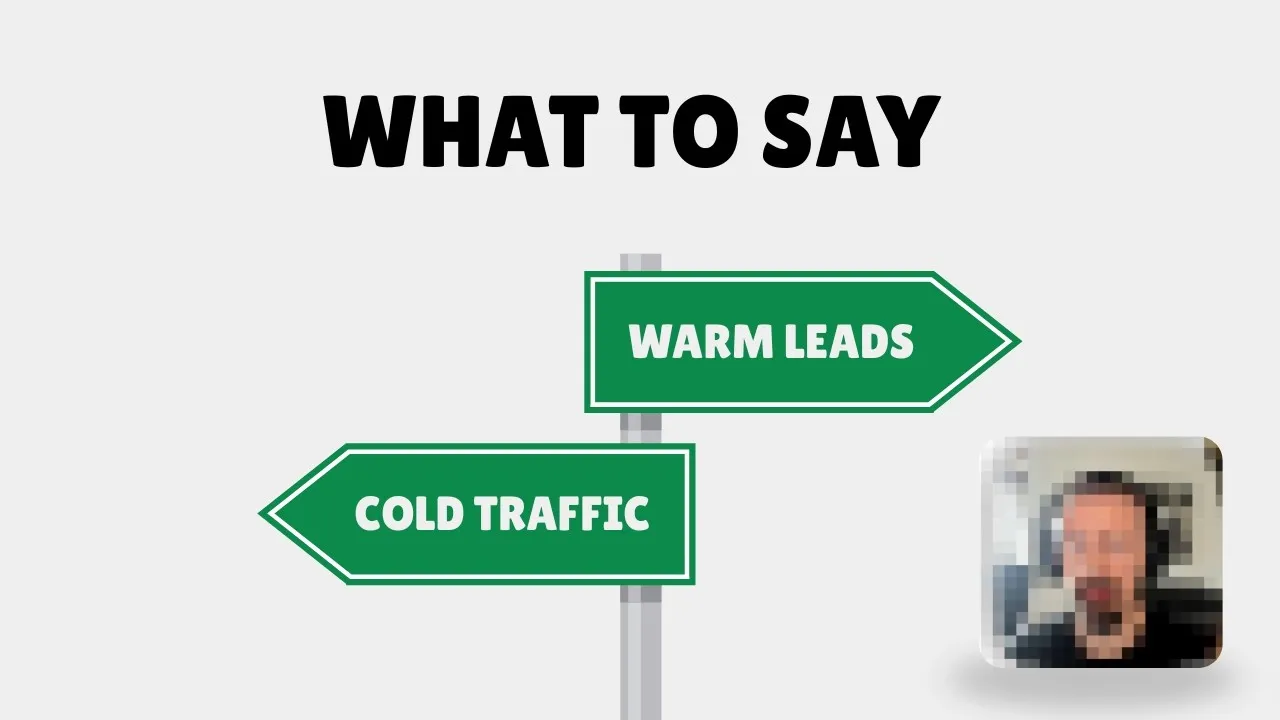
TL;DR: A B2B ad creative strategy fails when the message is aimed at the wrong stage of awareness, not because the creative is weak. Six angles, from pain through to downsides, run cold to hot. Whether you compress them into one ad or split them across several comes down to the buyer’s decision timeline.
Why do good ads fail on the right audience?
Because the message arrives at the wrong moment. You’ve scrolled past an ad that opened with a company announcing how excited it is to be hiring. You’ve scrolled past one offering 12% off an annual plan. Neither is badly made. Both are aimed at somebody who isn’t there yet.
The hiring ad opens with a problem that isn’t yours. The discount ad opens at the end of a conversation you’ve never had.
The problem is the position on the scale. On the left are people who have no idea who you are. On the right are people close to signing. Between those two ends there’s an order to what you say, and I lay the whole thing out from the first minute. The same thing happens on landing pages, where the channel sets the conversion rate before the page loads.
What is the creative angle matrix?
The creative angle matrix is a map of what to say at each stage of awareness, from cold traffic to a hot lead. Six angle groups sit along that line in order: pain and product for cold audiences, content and proof through the middle, differentiation and downsides near the bottom of the funnel.
The logic is a conversation held in the right sequence. First you name a problem the person recognises and say what you do about it. Then you show why you’re interesting and who else already trusts you. Only after that do you talk about how you compare and what it costs to do nothing.
It works for B2C as well as B2B, as I set it up at 1:01. The angles are the same either way. The difference is how far apart they have to sit, which is the last section of this piece.
Pain has four root causes: time, cost, money and skill
Probably every pain point a customer has falls into one of those four, or several at once. What you sell barely matters. A CRM, a chatbot, a consumer job-hunting app: the underlying complaint sorts the same way.
The four overlap, and it isn’t worth long arguments about where cost ends and money starts. The checklist is the point. Take a pain you know your customers have, work out which of the four it sits in, then write the line that names it plainly.
Selling a chatbot, the hook might be that you lose revenue every time a customer question waits more than five minutes for an answer. That’s cost and time in one sentence, which is exactly why it works on a stranger.
What belongs in a product angle?
A product angle says what you do, and specifically what it changes about the pain the ad just named. Do you make something faster, cheaper, easier, or possible where it wasn’t before? An angle that only lists features has skipped the part that connects it to the person watching.
Pain plus the change you make to it is what most people call a value proposition. That’s the join between the first two angles: pain earns the attention, product explains why the attention was worth spending. Where value props come from in the first place is its own argument between product marketing and growth.
One constraint. Use this angle for demand generation, where you’re interrupting somebody’s day on an ad platform. A person actively searching in Google or an AI assistant is in a completely different posture, and the same creative logic doesn’t carry across.
Consumable and usable content are not the same ad
Content angles answer who you are and why you’re interesting, and in B2B they split in two. Consumable content is something the reader takes in: a webinar, an event, an industry report, a framework they can read through. Usable content is something they operate.
Usable means a calculator on your site, a custom GPT you built for a job they actually do, a document template, a framework they can run against their own problem. B2C usually collapses both into one line: try this free, solve the problem with the product. That works when the product is the trial. In B2B the trial is months away, so content has to do the job the product can’t do yet.
What makes a proof angle land?
Recognition is what makes a proof angle land. A proof ad works when the person on screen looks like the person watching, has the same problem, and had it solved. Ratings, reviews, testimonials and case studies are the formats, and the resemblance is the requirement underneath all of them.
That’s why a case study from a company three sizes larger tends to move nobody. It proves you can do the work. It doesn’t prove you can do it for them.
Proof sits in the middle of the scale, just after content. By then the viewer knows the pain, knows what you do about it, and knows why you’re worth a minute. The only question left is whether it works for somebody in their position.
Where should differentiation and downsides come from?
Differentiation and downsides should come from your sales calls, not your positioning document. Differentiation is how you differ from what customers actually compare you against, and usually that isn’t the competitor set you’d name yourself. The only reliable source is what buyers say out loud, which I push on at 7:19.
How you want to be positioned is a different thing. It might even be right. It isn’t evidence, and an ad built on it tends to answer an objection nobody raised.
Downsides are the other bottom-funnel angle, and they’re blunt. What does it cost to not use us, to go with a competitor, to carry on the way you are. Both angles only work on somebody who already has the rest.
| Angle | What it says | What it looks like in B2B |
|---|---|---|
| Pain | The problem, in one of four root causes | Revenue lost while a question waits |
| Product | What you change about that pain | The thing that removes the wait |
| Content | Who you are and why you are interesting | A webinar, a report, a calculator, a template |
| Proof | Somebody like you, already solved | Case studies, ratings, testimonials |
| Differentiation | How you differ from the real alternatives | Lines lifted straight from sales calls |
| Downsides | The cost of not acting | What another quarter of this costs them |
Decision timeline decides whether you compress or segment
You’ve seen ads that hit every angle at once, and they work. That works when the decision is fast, not because it’s B2C. A $30 self-serve product and a $3,500-a-month contract aren’t the same risk for whoever signs.
When the decision is small and fast, one ad can carry the whole sequence. Here’s the pain, here’s what we do about it, here’s who else solved it, here’s what it’s costing you today. The viewer can run that conversation in fifteen seconds, because being wrong costs them almost nothing.
When the decision is slow and expensive, the same ad asks for far too much far too early. Better to segment creative by angle, with each concept carrying one or two rather than all six, which I work through at 11:19.
In practice that looks like a handful of concepts running at once. One on pain and product. One pairing proof with differentiation, showing an outcome that happened because you work differently. One pushing a downloadable lead magnet through the middle of the funnel. And one built to move a lead from MQL to SQL after a few sales conversations have already happened.
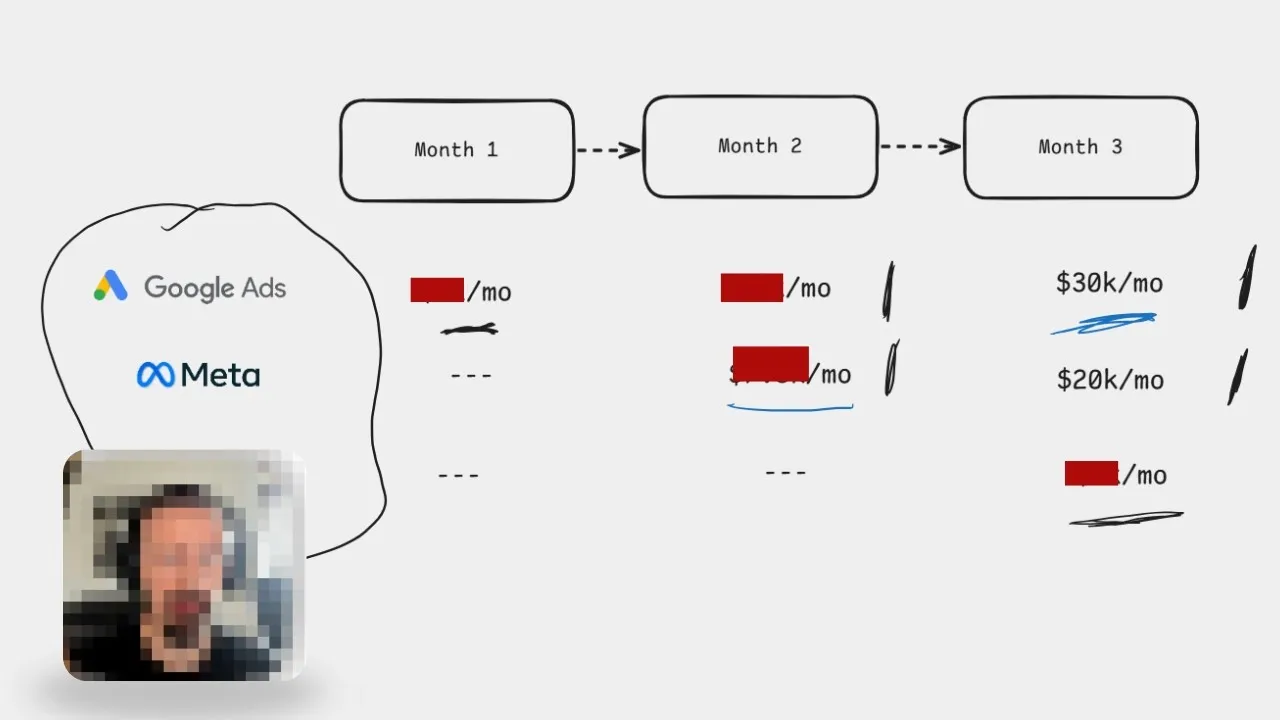
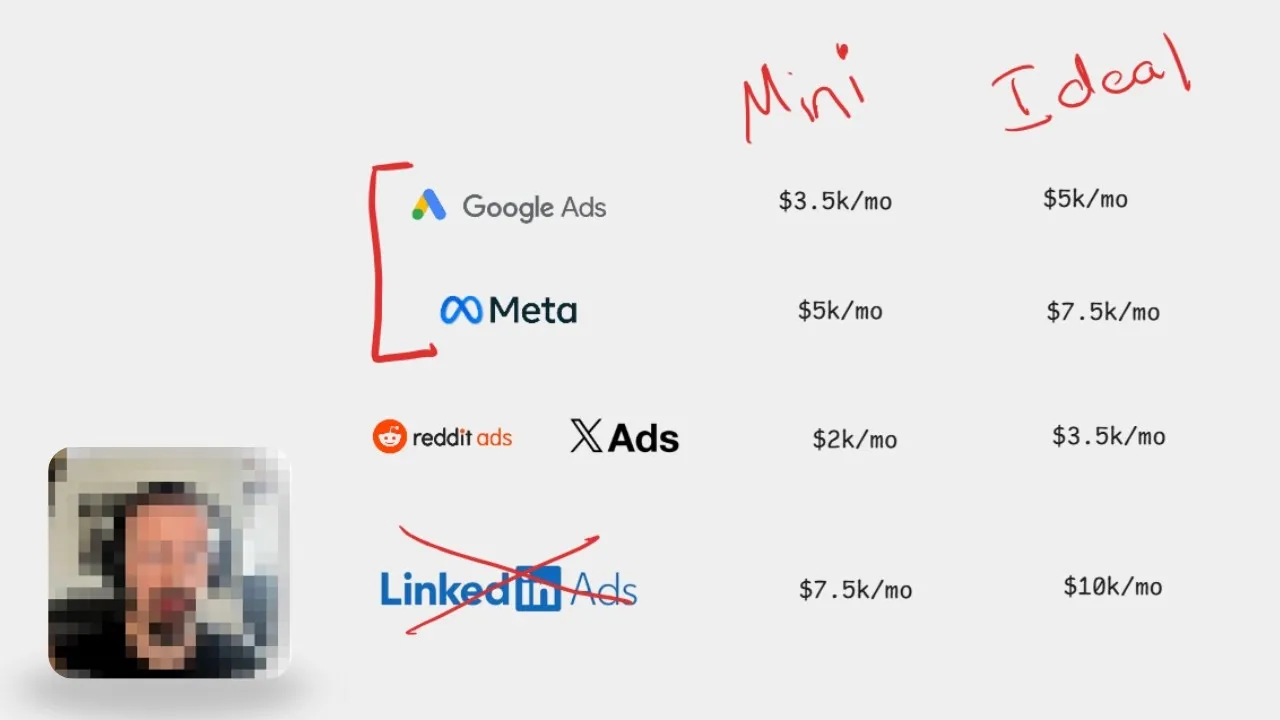
How many you can afford to run at once is a budget question, and how the first $50k a month gets split across channels is where I answer it.
That last concept only works if the account can see what stage a lead is in. Your B2B ad creative strategy and your conversion event setup are the same plan from opposite ends: the angles move a buyer down the funnel, and the events tell the platform it happened.