TL;DR: The argument about who owns what isn’t about seniority, it’s about measurement. If a job has too many uncontrolled variables to test against a number, product marketing should own the narrative; if the feedback comes back as analytics, growth marketing should own the execution. Nearly every disputed responsibility sorts on that one question.
Why do product marketing and growth keep arguing about this?
Both teams are right about the half they can see. Product marketing owns the story the company tells. Growth marketing owns the numbers that come back from telling it. The argument starts when one piece of work sits inside both at once, which is most of the interesting work.
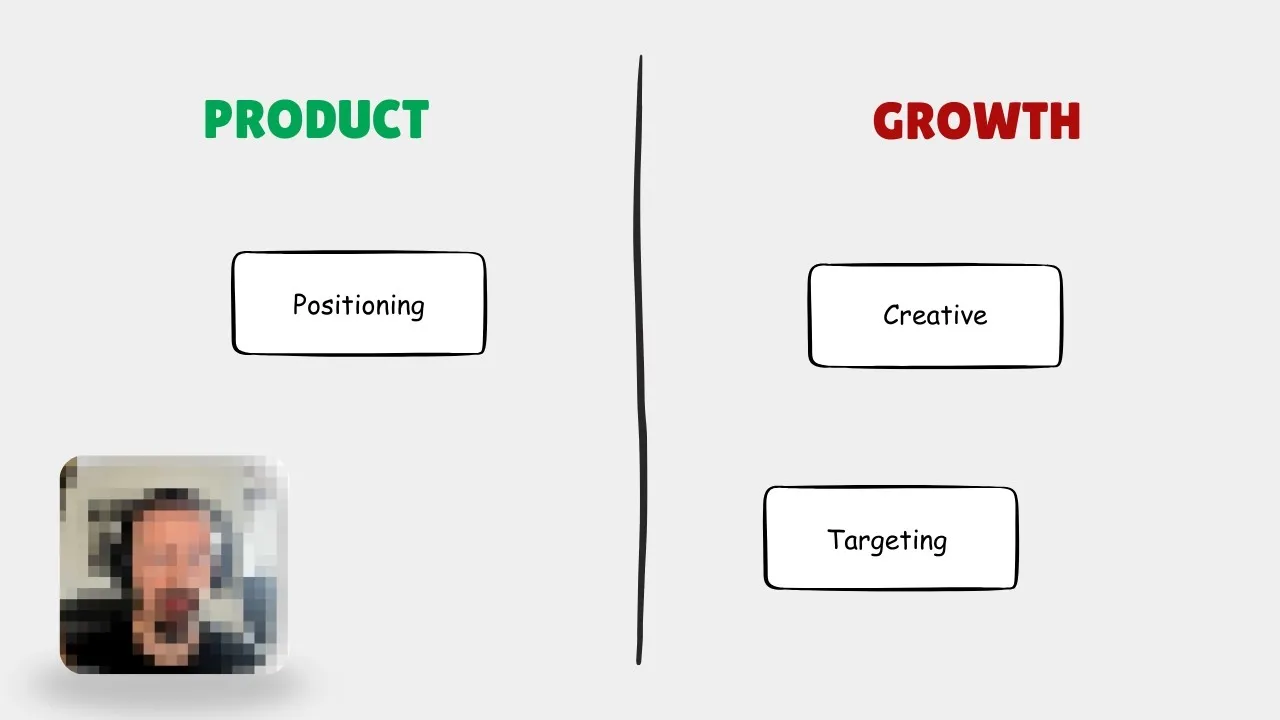
The way out isn’t a list of job titles. It’s a scale. Pure product marketing at one end, pure growth at the other, and every responsibility dropped where it belongs rather than where the org chart puts it. I walk the whole thing from the first minute of the video.
What follows is that scale in writing, plus the rule underneath it. If you’re building the team rather than refereeing one, what to look for in a growth marketer is the companion piece.
What decides who owns what?
One question: can you change this thing and read the result in a number? Where the answer is yes, the analytical team should be making the changes. Where the answer’s no, because too many other variables move at the same time, the right kind of ownership is a narrative opinion instead.
That sounds like a small distinction. It’s the whole argument.
A narrative opinion says: put this before that, and here’s why. An analytical opinion says version C beat version A by enough to call it. The failure mode is reaching for the second kind where only the first is available. Nobody should be claiming that moving a slide lifts close rate by a given percentage, because nothing in that sentence can be pulled apart from the rep, the buyer and the deal.
Sales enablement and social proof belong to product marketing
Sales enablement and social proof both sit at the far left of the scale, for the same reason: neither gives you much to measure. A deck goes into a call with a specific rep, a specific buyer and a specific deal, so there’s very little clean analytics to pull back out of it. The best ownership available is a strong opinion about how the information should be presented, which I get into at 0:41.
Social proof works the same way on the creation side. Customer stories, testimonials and quotes get captured and curated by product marketing, and growth doesn’t need much of a view on how that’s done. You’re not manufacturing reviews. You’re collecting them.
Distribution is a different question, and there the answer flips. Whether a testimonial runs in an ad, in an outbound sequence or in a pre-call nurture email is entirely growth’s decision, because that one has a number attached to it.
Who owns copy and creative?
Growth, just barely. Copy and creative sit slightly right of centre. The positioning they express comes from product marketing, but growth ships the variants, because growth holds the performance data.
After six versions of a subject line you know which one worked, and you know it from a number rather than a preference. You don’t want that call made by an opinion with nothing behind it.
So the two halves look almost identical and aren’t. Messaging is the overall story you’re trying to get across. Copy is the exact wording of the outcome delivered to a specific audience. It’s also where the events you bid on start to matter, because the number that settles the argument comes from whatever the ad account is optimising toward.
Who owns the ICP, and who owns who you actually target?
Product marketing defines the ICP. Growth decides who gets targeted. Those are two different jobs that teams routinely treat as one, and collapsing them is how you end up with a clean ICP document that no campaign can act on.
The first version of the definition comes from market research, not from a funnel readout. It describes who you’re trying to reach and why. Later versions get corrected by who growth actually brings in the door.
Targeting sits at the opposite end. If an ICP can’t be reached through any available channel, or only at a cost that never pays back, going after it wastes time no matter how clean the definition is. That call belongs to growth, and I make the case at 4:18.
Audience segmentation sits just left of targeting. Your ICP contains several personas, and once you break out those groups you can see how each one is reachable. Product marketing should understand how the segments are built and how growth can act on them.
Pricing, tiers and launches sit in the middle
Neither team owns pricing, and it’d be strange if either did. Finance has an opinion, sales has an opinion, and everybody cares what one contract is worth. What product marketing should own is narrower: why this tier, for whom, and what belongs inside it.
Product launches land in the middle for a similar reason. One side decides what assets exist and who the audience is. The other decides which slice of that audience is reachable, how to reach it, and whether the money comes back.
Where do messaging, positioning and value props land?
They stack in a column rather than sitting at a single point. Messaging and positioning are the overall story. Value propositions are the specific pain points that fall out of it, from the product’s features and from what you hear on sales calls. Copy and creative are what that becomes in an ad account.
Positioning belongs to product marketing. Copy belongs to growth. Value props sit between them and get pulled both ways: they come straight out of the positioning, but they’re measured on click and conversion performance, which is where I land them at 9:06.
That’s not a conflict, it’s the handoff. A value prop gets written once and then tested repeatedly against different leads and different customer types. The next step, turning value props into an actual ad framework, is its own video.
The whole scale, in one table
Twelve responsibilities, sorted by that one question. KPI ownership needs the least argument of any of them, so it lives in the table rather than in a section of its own: growth’s performance gets measured in a number, and product marketing’s gets measured creatively and by influence. If your product marketing team is KPI driven, something has gone wrong upstream of this scale.
| Responsibility | Where it lands | Why |
|---|---|---|
| Sales enablement | Product marketing | Too many uncontrolled variables to test |
| Social proof, created | Product marketing | Capture and curation, not optimisation |
| ICP definitions | Product marketing | Research and intent, not a funnel readout |
| Messaging and positioning | Product marketing | The story everything else expresses |
| Pricing and tiers | Middle, with finance and sales | Product marketing owns why this tier, for whom |
| Product launches | Middle | One side sets the assets, the other sets the reach |
| Value propositions | Middle | Written from positioning, measured on performance |
| Audience segmentation | Just left of targeting | Personas defined, then made targetable |
| Copy and creative | Growth | Variants come back as numbers |
| Social proof, distributed | Growth | Placement is a performance decision |
| Who you target | Growth | Reachability and cost decide it |
| KPI ownership | Growth | That’s what the job is |
Disagree with a placement? Check it against the question, not the job description. Can you change the thing and read the result in a number?
That’s also the clearest thing to hand somebody new. If the split on your team is causing friction, tell me what it looks like, or see what it looks like on the teams I work with.