TL;DR: A landing page test changes two things, not one. It changes what the page does with the traffic you have, and it changes what the ad platform learns about the traffic worth sending you. Most teams measure the first and leave the second on defaults.
Why does a landing page test move more than the landing page?
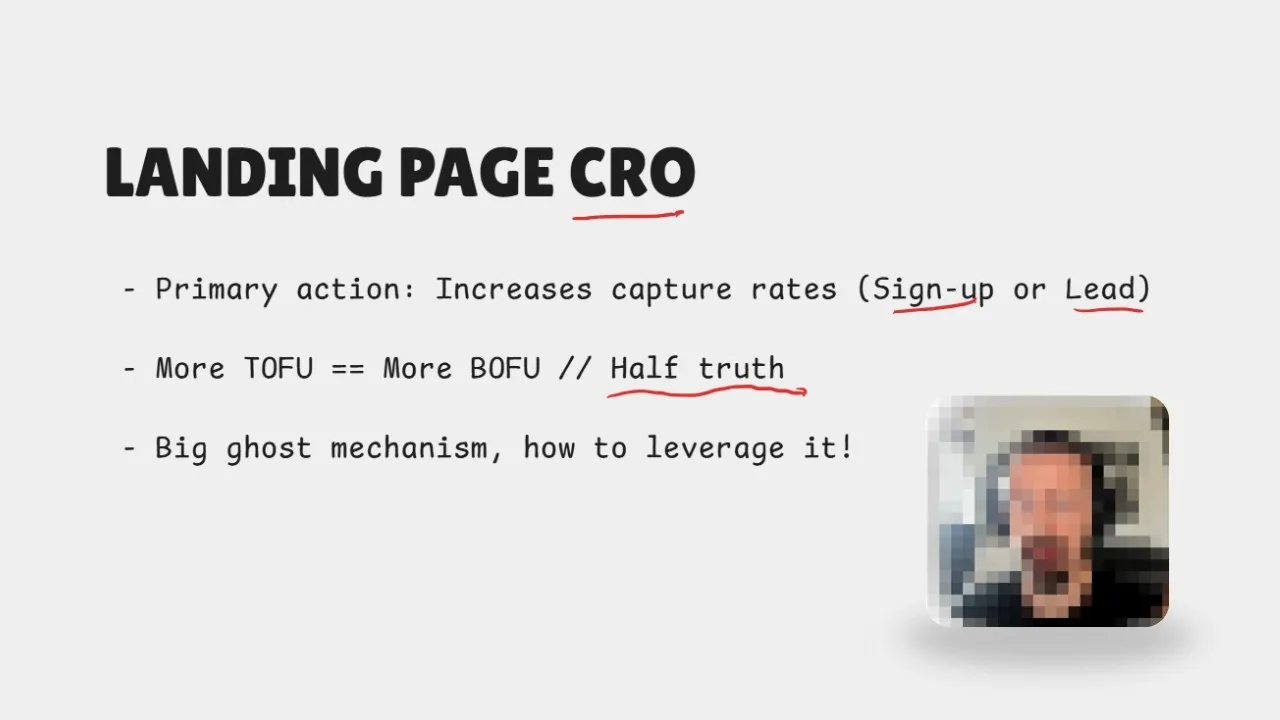
The usual story is that a better page converts more of the same visitors, the top of the funnel grows, and revenue follows. That is true, and it is half of what happens. The other half is that your conversion rate was partly set before anyone arrived, by the channel that sent them.
That half is invisible in a standard test readout. You see the rate move, you credit the new headline, and you file the result under page design.
It matters because the two halves have different ceilings. Page design runs out of room fairly quickly. Traffic quality does not, and it is the one most teams never touch. I set the framework up in the opening minute of the video.
What does your channel source have to do with your conversion rate?
Every visitor arrives pre-qualified, or not, by the thing that sent them. Someone who typed a query into Google has already told you what they want. Someone served a video ad mid-scroll has told you nothing, because they were not looking for you when you interrupted them.
Put the two side by side. A Google search click came from someone who wrote the words for their own problem, which is a qualification step they performed on themselves. A TikTok or Meta click came from someone whose afternoon you interrupted, and who is now deciding whether to care.
So organic search usually converts better on the page than paid demand generation does, before you change a single word. The page is the same. The intent behind the click is not. Two teams running the same page can report different rates, and the difference sits upstream of both of them.
Good creative narrows that gap. An ad that explains the product properly sends people who understand what they are clicking, and those people behave more like search traffic when they land. Say it plainly: ad creative qualifies people before it ever persuades them.
What happens when you feed conversion data back to the ad platform?
The platform stops guessing which clicks are worth buying. You send back which leads qualified and which did not, then bid on those events instead of on clicks or impressions. The bidding model starts looking for people who resemble your customers, rather than anyone willing to fill in a form.
Both large platforms are built for this. Google takes qualification and sale data through offline conversion imports and enhanced conversions for leads (Google Ads Help, 2026), and Meta takes server-side events straight from a CRM through the Conversions API (Meta for Developers, 2026).
Think about what the platform sees without that loop. A hundred people filled in the form, so it goes looking for more people like those hundred, including the students, the competitors and the ones who only wanted the PDF. Send back that a quarter of them qualified, and who that quarter were, and it narrows the hunt to that group. The filtering then happens before the ad is served, which is the part that moves your page’s numbers (4:56 walks through it).
The work is definition. Almost none of it is engineering. Marketing counts a demo request; sales counts the demo that showed up; finance counts the one that paid. Until somebody settles that argument there is nothing to teach a bidding model, which is the whole job in setting up conversion events for paid ads. Get the definition wrong and you have taught the platform to find more of the wrong people, faster.
Why does your conversion rate rise for two reasons?
Once the feedback loop is running, the landing page rate moves for two separate causes at the same time, and they compound. The page converts more of the people who reach it. The platform sends fewer people who were never going to convert.
| What changed | Conversion rate | Cost per qualified lead |
|---|---|---|
| The page alone | Up | Down a little, since the mix of people is unchanged |
| The feedback loop alone | Up, without touching the page | Down, and the leads behind it are better |
| Both | Up twice | Down twice, which is where the real economics move |
This is why a page test and a tracking project should not be run as separate projects with separate owners. Run together, each one makes the other look better than it is on its own. Run apart, you will attribute all of it to the page and keep optimising the smaller half (7:24 covers the double count).
What should you send back if you sell to consumers?
Send the whole journey. A free signup is the weakest description of a customer you have, and it is the one most PLG teams bid on, because it fires soonest and most often. Everything past it says something the platform cannot work out on its own: who stayed, who paid, and who paid a lot.
The useful list, in order of how much it teaches the platform:
- Free signup. Cheap, noisy, fires immediately.
- Activation. The moment someone did the thing the product is for.
- Purchase. Real money, smaller numbers.
- Plan and value. Which plan, at what price.
- Tenure. Who was still paying months later.
Each step up is a better description of a customer and a worse source of volume. Send all of them, then bid on the deepest event that still gives the platform enough data to learn from (8:07 goes through the B2C version).
In B2B, the same loop runs further down the funnel
In B2B the events worth sending sit past the form: SQLs, demos, negotiations and closed-won deals. Pipe those back and the model learns the shape of a buyer, with a job title and a company size, instead of the shape of somebody who likes downloading things.
The constraint is volume. A month of closed-won deals in B2B is often a handful of records, and no bidding model learns much from that. Most teams end up bidding on a qualified-lead event and using the closed-won data for reporting and exclusions instead.
There is a second reason to send the deep events even when you cannot bid on them. They make your reporting honest, and they let you exclude the accounts you never want to pay for twice.
Treat it as a sequence. Start at the event you fire often enough to be believed, then move the bidding event one step deeper each time the volume supports it. The same order of operations governs how you structure ad spend.
Where does this stop working?
At the upload window, and at your own data quality. Google will not import an offline conversion uploaded more than 90 days after the click, and cuts that to 63 days for enhanced conversions for leads (Google’s import guidelines, 2026). An annual renewal lands outside the window the platform will accept.
So retention makes a poor bidding event for most B2B, however good it looks as a business metric. Use what lands inside the window, and keep the slower outcomes for deciding where budget goes next quarter.
The other failure is quieter. If your qualification rules are wrong, the loop trains faithfully on the wrong definition, and your cost per lead improves while your pipeline does not. Audit the definition before you audit the ads.
What to do first
Look at the last landing page test you ran and ask which half of the mechanism you measured. If nothing about the traffic changed while the page did, you tested the smaller half of it, and the number you reported was a page number rather than a funnel number.
Then check one thing: whether a qualified lead in your CRM ever reaches the ad platform at all. For most teams the answer is no, and that is the work.
If you would rather have the loop running than read about it, building these systems is what I do.