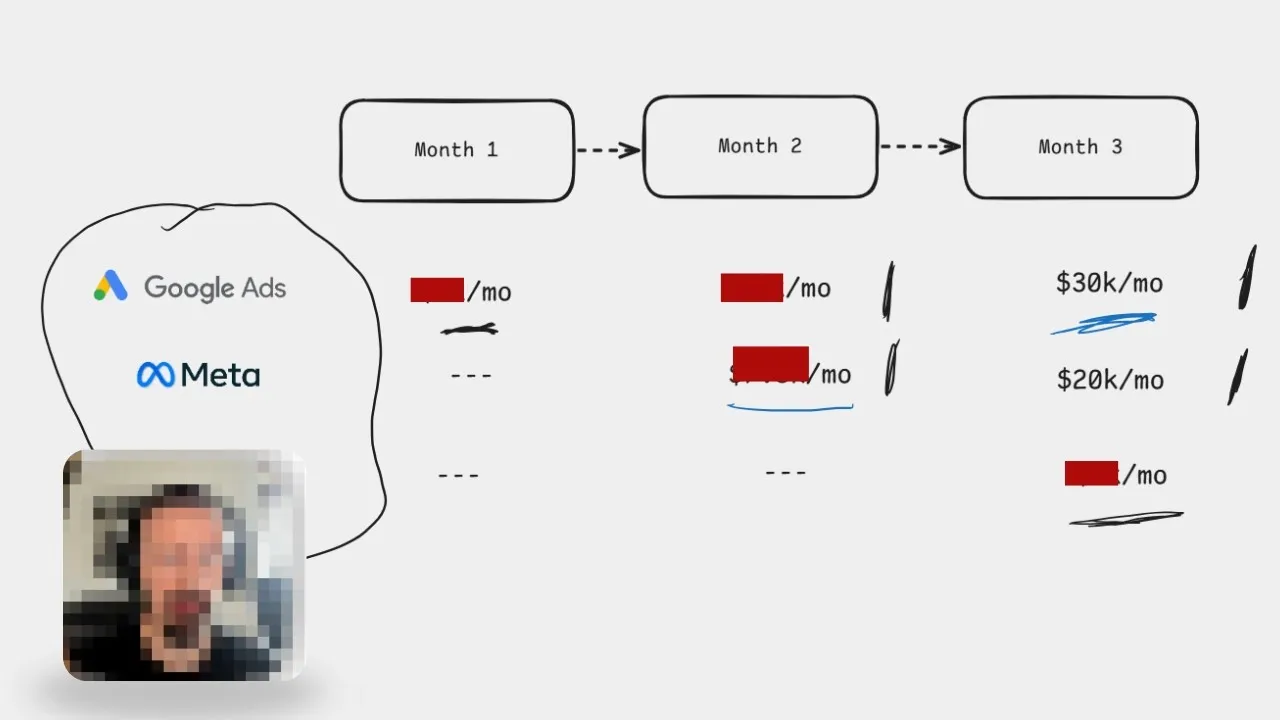
TL;DR: Spending $50k a month from zero is a sequencing problem, not a budgeting one. Month one is roughly $13k across two channels, not $50k across six. Decide your source of truth before you launch, or none of it is provable. Decide the number at which you kill a channel, or you’ll bleed into one.
What does spending $50k a month from zero actually involve?
It involves not spending $50k in month one. The scenario here is a new client or a new growth strategy with empty ad accounts, no conversion data, nobody trusting the tracking that exists, and a target of $50,000 a month in paid. Everything below assumes that starting point.
A few other assumptions worth stating. The goal is revenue. Community and audience come second to finding channels that buy customers profitably. We’re only looking at paid ads. And the company is B2B or B2C SaaS with no prior experience running this.
| The scenario | |
|---|---|
| Target | $50,000 a month in paid |
| Starting point | Empty accounts, not a dollar spent |
| Conversion data | None |
| Trust in existing tracking | None |
| Goal | Revenue, not audience or community |
| Business | B2B or B2C SaaS, no prior paid experience |
This half is the foundation and the roadmap: the tools, the theory of attribution, and where the money goes month by month. It deliberately skips what a Google account looks like inside, which is the account structures in part two. I set that split up in the first minutes.
Why don’t teams trust their own tracking?
Because they’re comparing two numbers that were never built to agree. The Stripe figure and the CRM figure don’t match what’s in the ad platforms, so the conclusion is that Google is lying, or Meta is lying, or the platform is inventing conversions. Neither system is lying. Nobody decided which one was right.
Define a source of truth for every event
The fix starts before any of the tooling. For every event in your conversion funnel, free and paid, you name the system that owns it.
If you’re measuring cost per MQL or cost per SQL, the source of truth is almost certainly your CRM, because that’s where a lead actually becomes an MQL. If you’re measuring revenue, sometimes it’s still the CRM and sometimes it’s the payment provider. For a product-led motion with self-serve signup, it’s whatever records the signup.
The specific system matters less than the fact that there’s only one of them per event, and that everyone agrees on it before money moves.
Pipe it back to the ad platform
Naming the source is half of it. The other half is sending that data back into whatever platform you’re buying from, so the platform can see what happened downstream of a click it sold you.
That’s what lets you look at a lead three weeks after the ad click and know what it became. Whichever of these you care about, the number in the platform should match the number in the source of truth:
- Conversions, meaning the count of whatever you’ve decided matters, from a form fill to a booked call.
- Conversion value, the dollar amount attached to each one, which is what lets a platform bid on worth rather than volume.
- Single purchases, usually straight from the payment provider rather than the CRM.
- Subscriptions, where the value of a conversion keeps moving long after the click that caused it.
- Free signups, the product-led equivalent, recorded wherever the signup actually lands.
Then you can say “I did X in the ad account and Y happened in the business” without anyone arguing about whose figure is real.
One more thing about where this lives. Run all of your reporting out of the third-party tool. It works both ways: you do something in the ad account, and you see what it did in the source of truth. If reporting comes out of the ad platforms themselves, you’re back to asking which of them is telling the truth.
Which events to send, and which single one to bid on, is a whole subject of its own. I’ve written up the event ladder and where to start bidding separately, and the two fit together directly.
How do you choose a third-party attribution tool?
You choose it by the shape of your funnel, not by the feature list. Two questions settle almost all of it: is this a sales-led funnel, a product-led funnel, or both? And are you running ABM targeting, demand generation, or both? The answers drop you into one of three bands.
Sales-led, product-led, or both
The top band is ABM and sales-led, where deal sizes sit above $10k. Those tools cost more because they’re built to track expensive deals over long cycles. The middle band is for companies running a self-serve tier alongside some ABM and outbound tracking, which is most B2B SaaS in practice. The bottom band is purely product-led demand generation, where transaction values are in the hundreds a month rather than the thousands.
| Funnel shape | Tools | Typical cost | My pick |
|---|---|---|---|
| ABM and sales-led, deals above $10k | HockeyStack, Dream Data, Customer.io | Multiple thousands a month, usually annual | Dream Data |
| Both: self-serve plus some ABM | Spectacle, Hyros, Cometly | $100 to $1,000 a month | Cometly |
| Product-led and demand gen | PostHog, Mixpanel | Often free to start, then usage-based | PostHog |
The picks, and the bias in them
Starting from scratch without knowing the acquisition funnel, I take PostHog every time. In the middle band I take Cometly, and at the top I take Dream Data.
Those are the tools I’ve spent the most time in, so there’s some bias in it. With that said: PostHog is a significantly better tool than Mixpanel, and Cometly has been far more flexible than Spectacle or Hyros. HockeyStack and Customer.io are good, though at tens of thousands a year they ought to be.
If you’re weighing something outside that grid, email me and I’ll tell you which ones to avoid. There are tools that look comparable to these and aren’t.
The two tools everyone forgets
Alongside attribution, you want a session recording tool that does heatmaps, and a deanonymisation tool that does company API connections. I use Clarity for the first because it’s free and it works as soon as the pixel is on the site.
People forget both constantly, because they’re focused on measuring conversions rather than watching what users do after an ad. Both are cheap or free, and both start earning their place the moment you need to work out why a channel isn’t converting. I come back to them at 10:43.
| Tool | What it gives you | Why it gets skipped |
|---|---|---|
| Session recording with heatmaps | What people do on the page after the click | It measures behaviour, not conversions |
| Deanonymisation with a company API | Which companies are on the site at all | It looks like a sales tool, so marketing never buys it |
Month 1: launch two channels, not five
Two, and only two. Going from zero to $50,000 a month means risking $50,000 with zero confidence that any of it converts. So month one is about proving channels, and the two you pick have to meet one of two criteria: either they compound flow you already have, or they pay back fast.
Compounding what already exists
Compounding means looking at where your existing revenue actually comes from, now that the analytics are in place, and launching the channel closest to it.
If you already get organic search traffic, Google search ads are the obvious first move. If your users mostly arrive from Facebook groups, Meta compounds that and pays back quickly. If a large share of traffic comes from referrals and unknown sources, the fastest route to return is a Meta retargeting campaign against it.
Which channels to launch, and which to hold
Google is a launch, as long as it meets one of the two criteria, and it’s always fast to pay back. Focus on search, or on PMax with very tight audience setups so you aren’t distributing across irrelevant surfaces. Meta is an obvious launch too, though it’s generating demand rather than capturing it, so payback takes a little longer than an exact-match keyword.
Reddit is a good launch and something of a honeypot, because the targeting is so aggressive. You can go after specific subreddits, but confirm the audience is actually there and that you can run ads inside those subreddits at all. X sits in much the same place, with slightly harder targeting.
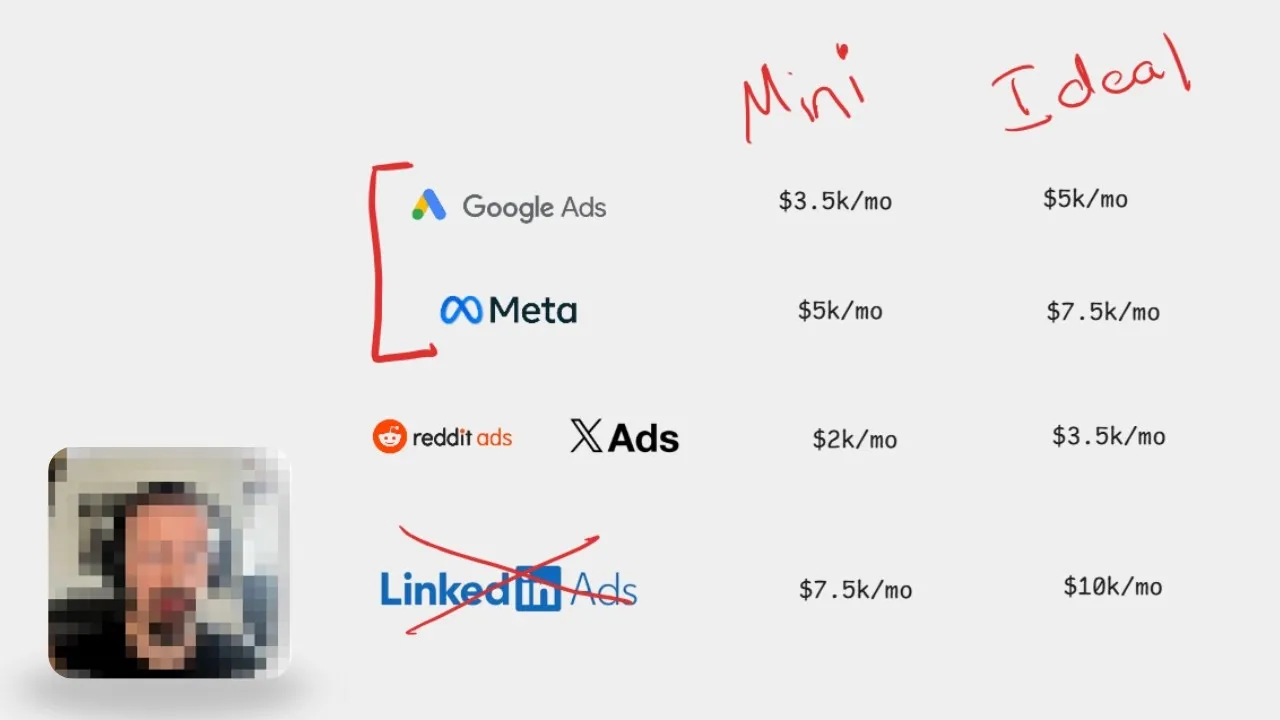
YouTube, Bing and LinkedIn go on the hold list, and none of that means never. YouTube’s problem is attribution: the journey is usually watch the ad, then go and search the brand off-platform, often on a different device and a different login. Unless the viewer clicks, there’s no way to show that ad produced that revenue. Add high creative costs and it’s a poor first channel.
Bing is a diversification play rather than a payback problem. On keywords it should be comparable to Google, but you’ll likely never spend $30,000 a month there, because the audience isn’t the size Google’s is. Launch it once you’ve already proved paid keyword search works.
LinkedIn is held for two reasons: the upfront cost per result is high, and the targeting engine isn’t what Meta’s or Google’s is. The one thing that moves it onto the launch list is a heavy ABM strategy where the total market is a known list of, say, 500 accounts. If only those people can buy, LinkedIn earns its place early.
What to budget in month one
Start each channel at a number meaningful enough to prove it and small enough that you aren’t burning tens of thousands to find out. I give both a floor and an ideal, because the floor is what you commit to leadership and the ideal is what gives you room to test.
| Channel | Minimum | Ideal |
|---|---|---|
| $3,500 a month | $5,000 a month | |
| Meta | $5,000 a month | $7,500 to $12,000 a month |
| Reddit or X | $2,500 a month | $3,500 a month |
Below $3,500 on Google you’ll never get enough data to run an experiment and learn anything from it. That holds whatever your ticket value is, B2B or B2C. At the floor you’re building a skeleton, not a full account.
On Meta the ideal band buys creative freedom and testing bandwidth, and that sits on top of whatever it costs you to produce the creative in the first place.
Reddit and X take smaller budgets, because the targeting is specific and the channels are small. Reddit will never reach the scale Meta and Google do.
Launch Google and Meta as your first two and you’re looking at roughly $12,500 to $15,000 in month one. Whatever combination you land on, that’s the month-one budget, and I break the numbers down at 12:12.
Month 2: scaling to half pace
The goal in month two is to take those two channels from launch budget to about 50% of your target pacing, so that month three can hit $50k. From $12,500 to $15,000, that means scaling to roughly $25,000 to $30,000 by month end.
Scaling to $25k is simple. Doing it profitably and sustainably is the actual job, and it’s the thing people are paying you for in the first place.
That means setting CAC and ROAS targets off the performance you now have, rather than off a number somebody picked in a board deck before any of this ran. You have a month of real data in two channels. Those are your targets until you have better ones. It also means knowing what is winning, what is not, and what the risk tolerance is of the people whose money this is.
Scale, iterate, or kill
By the end of month one each channel has fallen into one of three buckets.
The first and best is a channel already showing return. Here you just raise the budget, moving it up in increments that don’t reset the platform’s learning, and over a month you might double or triple that channel’s spend.
The second is the most common: not failing, not obviously working. Some cash coming back, no real return yet, which I’d put at anything below 2× ROAS. Almost every scenario leaves you with at least one campaign here. Three things fix it, and only three: the audience, the offer, and the angle. Iterate all three on a cycle and 2× tends to grow into two and a half or 3×. Which angles to try, and where each belongs in the funnel, is the creative angle matrix.
The third is failing, meaning you’re putting more in than you’re getting back. Below 1× return. That’s obvious over a long window and genuinely hard to see over a short one.
The 15× CAC rule
People rarely know when to kill a channel, because they assume a failing one will slowly turn into a working one. The rule of thumb: if you’ve spent 15 times your CAC target and there’s still no top-of-funnel evidence, kill it now, which I work through at 28:07.
Take a B2C case with a $50 CAC target. You’ve spent $750 on Google, and there are zero signups and obviously zero paid users. That’s a kill, and it goes back to strategy entirely. You’ve spent fifteen times your CAC and produced no measurable outcome at either end of the funnel.
The harder version is when the evidence exists but the revenue doesn’t: the same spend, 47 signups, no paid users. Now you do have top-of-funnel evidence and no return on capital. The answer isn’t to kill it, it’s to go into the tracking tool and look at what those 47 people are doing. If all 47 reach paid on a lag, cutting the channel kills a profitable one before it reported. If none of them engage with the product at all, you have your answer.
How do you judge a channel when deals lag?
You model it, because the 15× CAC rule stops being usable once deals take months to close. If your B2B CAC target is $1,500, fifteen times that is $22,500, and you cannot burn that much on one channel before showing anything. You need a read on the channel long before that number arrives.
This is exactly why the gap between the lead event and the closed-won event matters so much. Go into the CRM and build a model out of the conversion steps you already have: lead, MQL, SQL, negotiation, closed won. For each pair of stages, take the conversion rate from channels you’re already running.
With those rates you can translate forwards. A cost per lead today becomes a modelled CAC at the other end, and you can say that at this cost per lead, in sixty-five days, this share of leads converts into deals. That sentence is what justifies continuing to spend, or what justifies cutting the channel.
Where does leadership’s risk tolerance come in?
At the point where the data hasn’t arrived yet and somebody still has to decide. Leadership may have a very different view on how much spend to risk against how fast they want to grow, and that trade-off is the real conversation, not the budget spreadsheet.
The asymmetry runs both ways, and the second direction gets ignored. You can always dial a budget down. But if the board has revenue targets and leadership wants aggressive scaling, switching off a channel that later proves itself is genuinely bad news. You’ve lost a month of scaling on a channel that was working and just hadn’t reported yet.
My own tolerance for risk is high. That’s easy to say when I’ve deployed a strategy like this before and it isn’t my money. A bootstrapped company with two or three founders, on their first company, is in a completely different position, and they’re right to be careful, which is where I finish at 34:03.
So agree the tolerance before month one rather than during month two. What counts as evidence, what counts as failure, and how long a channel gets, are all cheaper to settle while nothing is on fire. It’s also the conversation I’d listen hardest to if I were hiring somebody to run this.
That’s the foundation and the roadmap for the first $50k a month of B2B ad spend. What goes inside each of those accounts, campaign by campaign, is the Google, Meta and Reddit structures. If you’d rather see the finished shape than the plan, the work is here.