TL;DR: Social proof has one job: carrying somebody from liking you to trusting you. The six types sort on how much they ask of a reader against how much they prove, and that sorting is what tells you where each one belongs. Depth this far down, skimmable stuff up top.
What is social proof actually for?
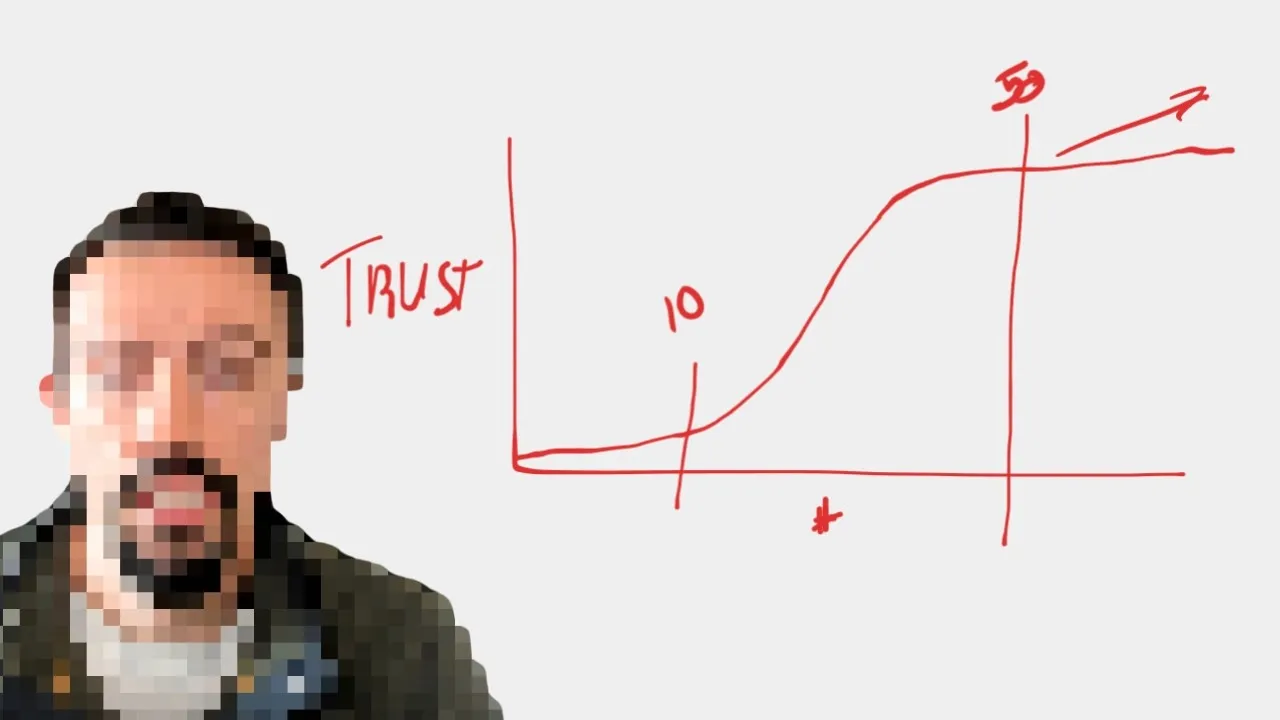
It closes one specific gap. Every customer journey runs know, then like, then trust, whatever the funnel looks like. Somebody finds you through an ad or a search, starts to like you from what you say, and then has to trust you before they sign up or pay. Social proof is what carries them across that last step.
That framing is the whole of it, and it’s worth holding onto, because it’s what makes the placement question answerable. I set it up at 0:21.
A thing that works at the trust stage can be worse than useless earlier. The same page element that closes a warm reader will bounce a cold one, which is the same problem the channel that sent them creates for a landing page test.
The six types, in one list
Stats are change points: a customer started at X and ended at Y. Sometimes they’re topical instead, a count of users or installs. Logos are the simplest form of name-dropping, and they only work when the names mean something to the person reading.
Ratings are stars and badges, the Trustpilot score or the G2 medal. Testimonials and reviews are both quotes, and they’re not the same thing. Case studies are the full customer story, problem through to solution. Mine are on the work page. References are peer-to-peer introductions, and they’re the rarest of the six.
What’s the difference between a testimonial and a review?
Who controls the quote. A review is created and captured independently, on Trustpilot or Google or anywhere the company has no hand in what gets said. A testimonial is curated, by marketing or by sales, which is why software sites are full of them.
That makes reviews the more trustworthy of the two, for exactly one reason: there’s no marketing filter on them. Nobody chose which ones you see. I draw the line at 1:56.
The trade runs the other way on control. A testimonial can be cut to the length a layout needs, and a review can’t, so testimonials are easier to design around even though they carry less weight.
Consumability against depth
Two axes explain where every type belongs. Consumability is how little the reader has to do. Depth is how much the proof actually establishes. Almost nothing scores well on both, and that tension is the whole framework.
Stats sit at the top of the consumability scale and the bottom of the depth one. They’re aggregations, they’re brief, and on their own they’re the least compelling proof you have. Logos are just as skimmable and slightly stronger, because a third party is involved and the claim can be checked.
Ratings and reviews take a little more work: you have to register which platform it came from and what it covers. Testimonials land beside reviews on both axes. Case studies are the mirror image of stats, all depth and almost no consumability. References sit furthest out.
| Type | What it is | Asks of the reader | Where it belongs |
|---|---|---|---|
| Stats | A change point, or a count | Almost nothing | Hero, ads, anywhere cold |
| Logos | Names the reader recognises | Almost nothing | Hero, ads |
| Ratings | Stars and badges from a platform | A glance | Near the primary action |
| Reviews | Quotes the company did not choose | A read | Mid-funnel, conversion pages |
| Testimonials | Quotes the company did choose | A read | Mid-funnel, conversion pages |
| Case studies | The full problem-to-solution story | Real time | Deep, warm traffic only |
| References | An intro to an actual customer | A conversation | After a sales call |
Why shouldn’t you run cold traffic to a case study?
Because you’re handing somebody a heavy piece of content and asking for a big investment of attention before they know or like you. A case study is the deepest proof you have and the least consumable, so it only pays off on a reader who already arrived warm.
Run ads to a case study page and make sure the audience already knows you. Cold traffic through a case study wastes the click and the asset at the same time.
This is the same rule as matching the ad angle to the stage of awareness, arriving from the other direction. Proof is one of those angles, and depth is what decides how far down it sits.
One more thing on logos while we’re here. I think trust in them has fallen over the last five years, because they get abused. A company uses a tool, then puts that tool’s logo on its site as though the tool were a customer. They still beat stats, because a third party is at least involved.
How does one company stack all six?
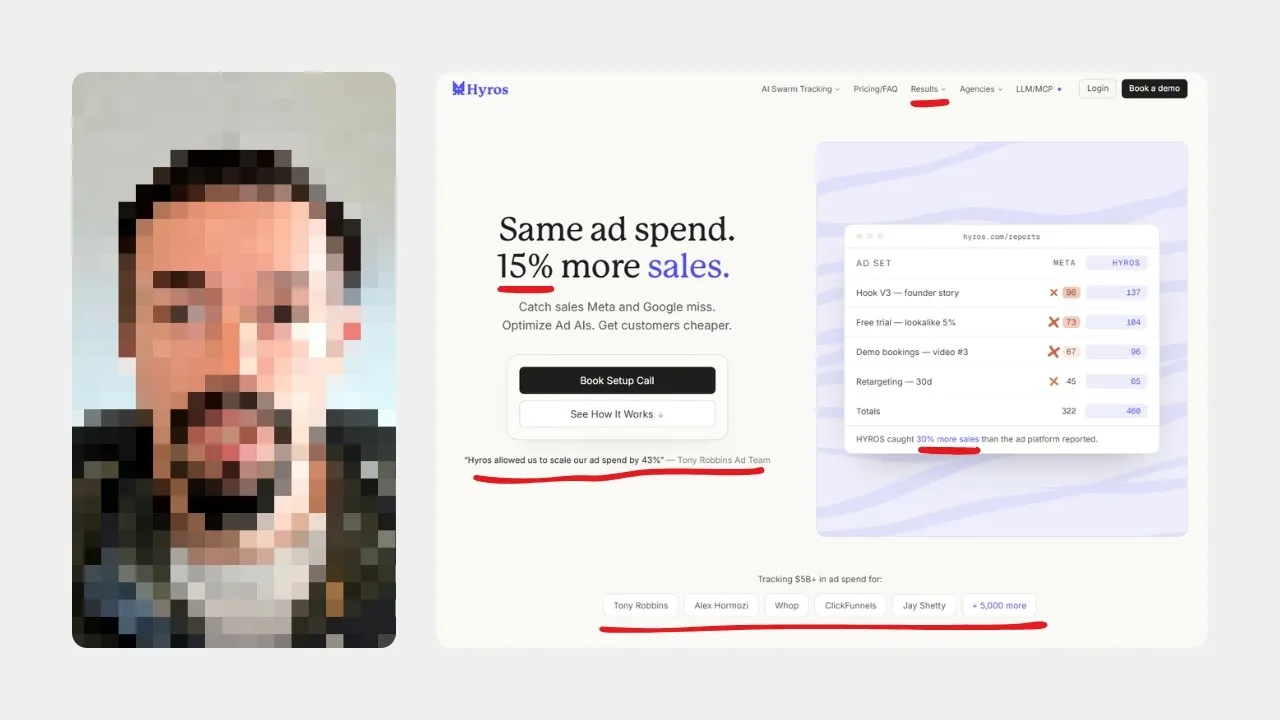
Hyros does it about as completely as anyone. They’re an ad attribution tool selling to agencies, ecommerce, and B2B and B2C software, and their funnel uses every type in journey order. I walk the whole thing from 6:31.
The homepage opens on a stat, in the change-point form: same ad spend, more calls, more sales. Then a quote from Tony Robbins’ ad team that does three jobs at once, because it’s a curated testimonial, it carries a number, and it name-drops a brand. Under it, a row of logos.
The results page is where the stacking gets dense. It reintroduces stats by business type, puts a Trustpilot badge with its rating count above the fold, then layers testimonials, another band of logos, then more testimonials.
That second set of testimonials does something different from the first. Rather than faces you compare yourself to, they’re faces you recognise from the industry. Same asset type, different job.
Case studies come last, and they’re sortable by industry, so a reader can find the one that resembles them. They’re the deepest thing on the page and they sit furthest down it, which is the framework doing its work.
Why is the third-party proof hidden?
Deliberately, and it’s the smartest thing on the page. The Trustpilot badge sits in every hero, but the actual third-party reviews are one click behind it rather than on the page. If you don’t believe the numbers you can go and check them, and if you do believe them you never leave.
The reason is landing-page fundamentals. External links on a conversion page send traffic away from the thing the page exists to do. Third-party proof is the most trustworthy kind you have and also the kind that lives on somebody else’s domain, so you embed the signal and bury the exit.
Which is a choice worth copying. Show the badge, keep the click.
References are the last one, and the rarest
A reference is an introduction to an actual customer, and in software it barely happens. Where it does happen, and particularly in high-ticket B2B, it can be the highest-converting proof you have. Nothing you write about yourself competes with a peer saying it on a call.
Hyros do it right at the end. Book a call, speak to their team, and afterwards they send you the email address of another company trying to do the thing you described wanting to do. That’s the deepest proof in the stack arriving at the deepest point in the journey, which is where I finish.
Worth noticing what that requires: somebody has to have listened on the call closely enough to pick the right customer. The proof is peer-to-peer, but the matching is sales work.
All of which assumes you have proof to place. If you are launching with none, what to borrow before you have customers is the half that comes first, and which customers to feature once you do is the half that comes after.
So the whole thing reduces to one question per placement. How much does this ask of the reader, and has the reader given me enough yet to ask it? Get that right and proof closes the gap. Get it wrong and you hand a stranger a case study.
Who builds this and who places it is its own argument. The stories get captured on one side of the house, and where they run is a performance decision. If you want a read on which proof your funnel is missing, tell me what you’re running.